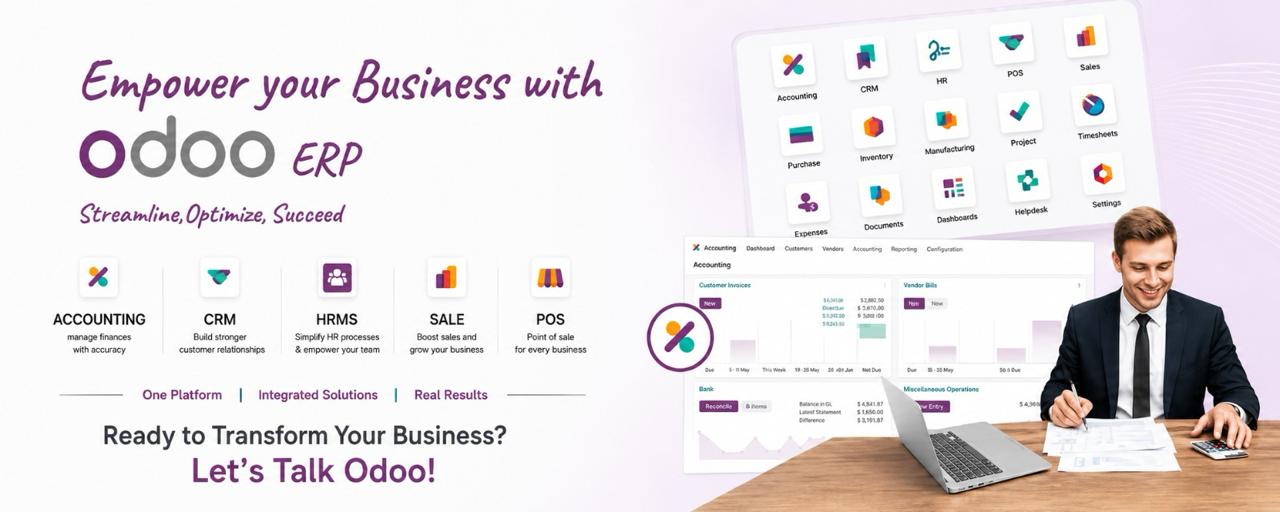
Running a growing business often means managing multiple departments, software applications, spreadsheets, customer records, invoices, employees, inventory, and sales processes. When these systems operate separately, businesses can face duplicate data, communication gaps, reporting delays, and inefficient workflows.
Odoo ERP provides a powerful way to bring essential business operations together on one integrated platform. From accounting and CRM to HRMS, sales, POS, inventory, manufacturing, and project management, Odoo helps businesses streamline processes and improve operational efficiency.
What Is Odoo ERP?
Odoo ERP is an integrated business management software platform designed to connect different business functions within a single system.
Instead of using separate applications for accounting, customer management, inventory, sales, human resources, and other operations, businesses can use Odoo modules that work together and share data.
This integrated approach helps organizations maintain better visibility across departments while reducing manual work.
Why Choose Odoo ERP for Your Business?
Businesses need technology that can adapt as they grow. Odoo offers a modular approach, allowing organizations to select the applications they need and expand their ERP system as their requirements change.
1. Centralized Business Management
Odoo brings key business operations into one platform. Management teams can access relevant information without constantly switching between different systems.
2. Better CRM and Customer Management
The Odoo CRM module helps businesses organize leads, opportunities, customer information, follow-ups, and sales activities.
A centralized CRM system allows sales teams to manage customer relationships more effectively and track opportunities throughout the sales cycle.
3. Efficient Accounting and Finance
Odoo Accounting helps businesses manage essential financial activities such as invoices, vendor bills, payments, reporting, and financial records.
Having accounting connected with sales and other business operations can help improve financial visibility.
4. Streamlined HRMS
Managing employees manually can consume valuable time. Odoo HR-related applications can help businesses organize employee information and simplify various HR processes.
This allows HR teams to spend less time on repetitive administrative tasks and more time supporting employees.
5. Sales and POS Management
Odoo Sales helps businesses manage quotations, sales orders, customers, and sales activities.
For retail and other businesses that require point-of-sale operations, Odoo POS provides an integrated solution for managing transactions while connecting sales information with other business processes.
6. Inventory Management
Inventory accuracy is essential for businesses dealing with products and stock.
Odoo Inventory can help businesses manage products, stock movements, warehouse operations, and inventory-related activities from a centralized platform.
7. Manufacturing Management
Manufacturing businesses require effective coordination between production, inventory, purchasing, and sales.
Odoo Manufacturing helps organizations manage production-related workflows while connecting manufacturing operations with other ERP modules.
8. Project and Timesheet Management
For service-based organizations and project teams, Odoo provides tools for managing projects, tasks, timesheets, and employee activities.
This can improve project visibility and help businesses monitor work progress more efficiently.
Key Odoo ERP Modules for Business Growth
Depending on business requirements, organizations can use different Odoo applications, including:
- Accounting & Finance
- CRM
- Sales
- HRMS
- Point of Sale (POS)
- Inventory
- Purchase
- Manufacturing
- Project Management
- Timesheets
- Expenses
- Documents
- Dashboards
- Helpdesk
The major advantage is that these applications can work together, creating a connected business management environment.
How Odoo ERP Improves Business Efficiency
One of the biggest challenges for growing organizations is disconnected information. When every department uses different systems, employees may spend significant time transferring information manually.
With Odoo ERP, connected workflows can help businesses:
- Reduce repetitive data entry
- Improve access to business information
- Connect sales and accounting processes
- Improve inventory visibility
- Organize customer information
- Simplify internal workflows
- Generate useful business reports
- Improve collaboration between departments
- Support business growth with scalable applications
Odoo ERP Suitable for Small and Growing Businesses?
Yes. Odoo ERP can be suitable for businesses of different sizes, particularly organizations looking for an integrated platform that can grow with their operational requirements.
A business can begin with the applications it needs most and add additional modules as operations expand.
For example, a growing company might initially use CRM, Sales, and Accounting and later implement Inventory, HRMS, Manufacturing, POS, or Project Management.
This modular approach can make ERP adoption more flexible.
Odoo ERP Implementation: What Businesses Should Consider
Choosing an ERP platform is only one part of a successful digital transformation strategy. Proper implementation is equally important.
Before implementing Odoo, businesses should evaluate:
- Business requirements
- Existing workflows
- Required Odoo modules
- Data migration requirements
- Third-party integrations
- Customization requirements
- User roles and access
- Employee training
- Testing and deployment
- Post-implementation support
Working with an experienced Odoo implementation team can help businesses configure the platform according to their specific operational needs.
Frequently Asked Questions About Odoo ERP
What is Odoo ERP used for?
Odoo ERP is used to manage and connect business operations such as accounting, CRM, sales, inventory, HR, POS, purchasing, manufacturing, projects, and other workflows.
What are the main benefits of Odoo ERP?
The key benefits include centralized business management, connected workflows, improved data visibility, reduced manual processes, modular applications, and scalability.
Can Odoo ERP be customized?
Yes. Odoo can be configured and, where necessary, customized to support specific business workflows, reporting requirements, integrations, and operational processes.
Is Odoo suitable for small businesses?
Odoo can be suitable for small and growing businesses because organizations can start with the applications they need and expand their ERP environment as their requirements increase.
Which Odoo modules should a business use?
The right modules depend on the organization’s industry and requirements. Common applications include CRM, Sales, Accounting, Inventory, HRMS, POS, Purchase, Manufacturing, and Project Management.
How does Odoo help businesses grow?
Odoo connects multiple business functions through one platform, helping organizations improve workflow visibility, reduce repetitive tasks, organize information, and manage operations more efficiently.
Transform Your Business with Odoo ERP
Businesses today need more than individual software tools. They need connected, efficient, and scalable business management solutions.
With applications covering accounting, CRM, HRMS, sales, POS, inventory, manufacturing, projects, and more, Odoo ERP can help businesses streamline operations and create a more connected working environment.
Whether you are moving away from spreadsheets, replacing disconnected software, or upgrading your existing ERP system, Odoo can provide a flexible foundation for digital business management.
Ready to transform your business? Let’s talk Odoo!